
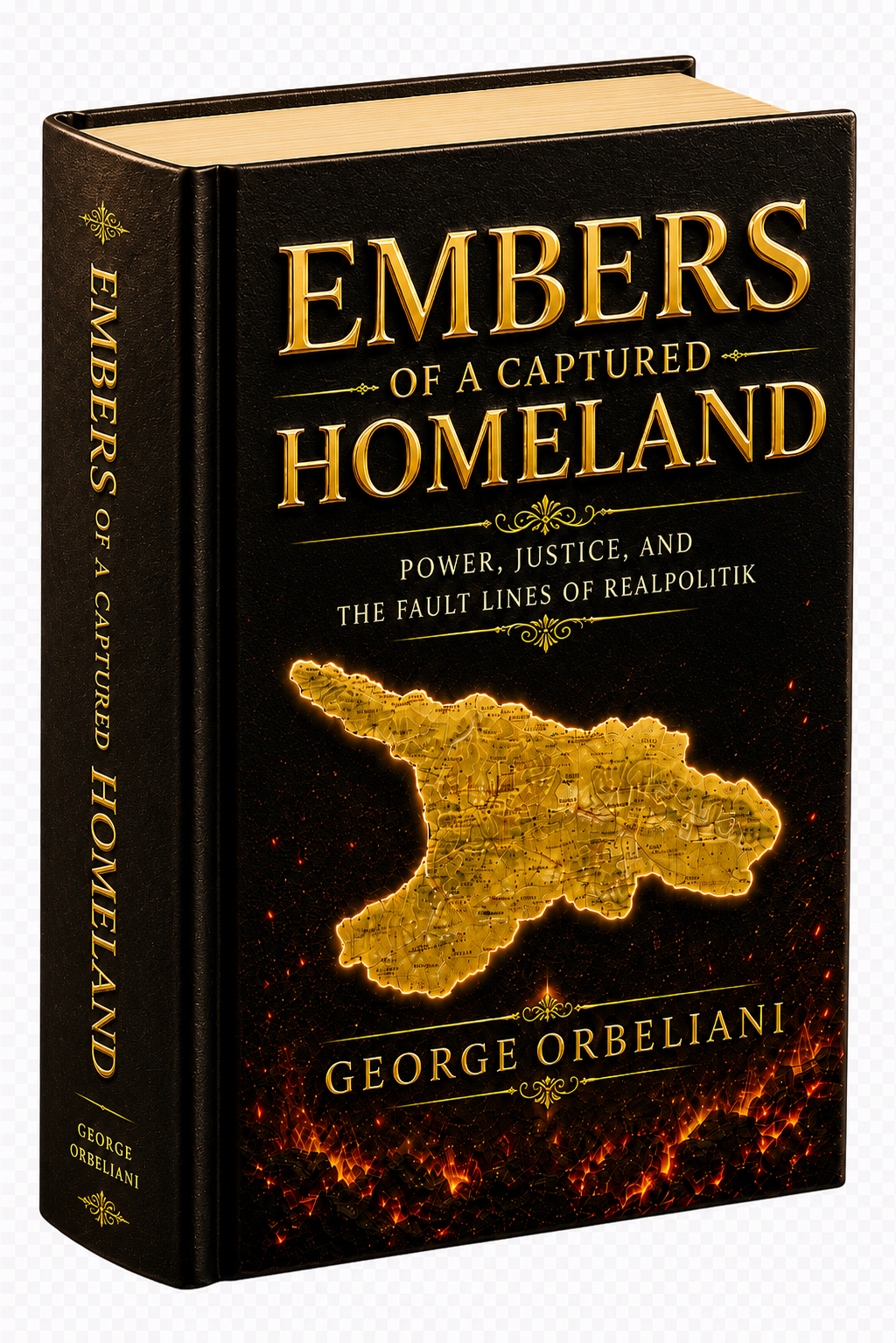
Embers of a Captured Homeland
Power, Justice, and the Fault Lines of Realpolitik
Embers of a Captured Homeland is a sweeping interdisciplinary study of Georgia’s unfinished struggle for sovereignty, justice, and democratic statehood. Integrating diplomatic history, international relations, international law, political thought, and geopolitical analysis, the book reinterprets the formation of the postwar international order through the unresolved question of Georgian sovereignty. Grounding its analysis in the foundational rupture of the 1921 Bolshevik invasion and extending to the present day, the book argues that many of the central questions surrounding Georgia’s statehood, territorial integrity, democratic development, and constitutional continuity have remained either insufficiently examined or fundamentally misunderstood. Although Georgia has repeatedly stood at the crossroads of major geopolitical transformations—from the collapse of empires and the rise of totalitarianism to the Cold War and the post-Soviet era—its historical experience has often been interpreted through ideological assumptions, geopolitical priorities, inherited historiographical conventions, and competing political agendas. Georgia’s modern history in a fundamentally novel perspective—refuting entrenched myths and exposing the strategic, ideological, and moral compromises that undermined the restoration of the nation’s historical legacy, cultivated anti-Western sentiment, facilitated pro-Russian realignment, and paved the way for the emergence and consolidation of authoritarian regimes.
The book contextualizes Georgia’s path within a sweeping historical framework, encompassing its brief independence (1918–1921); the subsequent Bolshevik invasion, “Red” Terror and Stalinist purges of the 1920s–30s; the Kremlin’s covert entanglements with the Georgian government-in-exile; shifting geopolitical dynamics before and after World War II; Cold War diplomacy and evolving U.S. foreign policy toward the Soviet Union, shaped by Containment, Détente, and Rollback; struggle for power in the Kremlin; the Soviet crisis and the illusion of Perestroika; dissolution of the Soviet Union and turbulent period of regaining independence; Kremlin-orchestrated political upheavals during the post-Soviet transition; and the present-day authoritarian resurgence exemplified by Moscow-backed proxy regimes.
Current Status
The book is currently in progress. Inquiries regarding academic collaboration, research dialogue, or publication interest are warmly welcome.